
Ignoring Pentecost to our peril

 Adobe
Adobe
 ChatGPT
The Oxford Dictionary of the Christian Church reminds us that Pentecost ranks as the second most important festival day in the Church following Easter, the celebration of Jesus' resurrection. However, many preachers ignore the day and its related themes. If Pentecost, which follows 50 days after Easter, is so important, why don't Christians gather their families for a special dinner? Why don't merchants announce the number of shopping days left until Pentecost? Why don't we buy new outfits for the occasion?
Congratulations to the Presbyterian Media Mission. For 40+ years it has promoted a Pentecost Party, encouraging parishioners to wear at least one piece of red-colored clothing to symbolize the fire of the Holy Spirit and to share a piece of cake to celebrate the birthday of the Christian Church.
Survey of TV preachers
During a recent Pentecost Sunday, I conducted an experiment by clicking around TV channels and discovered that only three of more than 50 programs which I surveyed covered Pentecost topics: a nationally televised Roman Catholic mass, a large Lutheran church service and a brief Lutheran broadcast designed for shut-ins. The other TV preachers, even the Pentecostals and Charismatics, apparently believed that the day and its related subjects were not important. Couldn't they interrupt a sermon series to preach about God the Spirit or the birthday of the church?
Why do preachers avoid discussing Pentecost?
Some may object to the Elizabethan expression "Holy Ghost" which evokes fear not friendliness. In addition discussion about the Holy Spirit may bring to mind an association with groups and experiences that seem different or strange. Also, after the resurrection, the Holy Spirit does not build up "Himself," but continually points to Jesus. Some might even see the Holy Spirit as only the third in command or an impersonal agent of God.
The dictionary reveals another possible reason some ignore or bypass dealing with these themes. The word "holy" means to be set apart and separated from the ordinary. Reverberations of Faith by Walter Brueggemann points out that in the biblical sense to be holy is to be lifted far beyond our uncleanness and to have a unique character (that of Yahweh). We are granted holiness in our belonging to, being devoted to and existing for the Most High God.
Others may avoid preaching about the Holy Spirit because, in the first place, the Spirit is impossible to completely comprehend. Rudolf Otto coined the Latin phrase "mysterium tremendum et fascinans" translated as the utterly fascinating and awe-inspiring mystery.
Second, the Holy Spirit brings high voltage. In Teaching a Stone to Talk Annie Dillard warns complacent people: "We should all be wearing crash helmets… For the sleeping god may wake someday and take offense or the waking god may draw us out to where we can never return." The Holy Spirit is the enemy of apathy and mediocrity. The Holy Spirit knows of our sin and of our rebelling and going over to the enemy side. (Check the meanings of the three words for sin in Psalm 51.)
Confusion about the spirit world
Finally, pastors often do not want to delve into detailed explanations about counterfeit gods of our culture or spirits in the other major religions and from animistic religions. But Galatians 4:8 warns: "Once you were ignorant of God, and enslaved to 'gods' who are not really gods at all…how can you want to go back to elemental things like these, that can do nothing and give nothing and be their slaves?" (The Jerusalem Bible translation) And we recall I John 4:1, "Beloved, do not believe every spirit, but test the spirits to see whether they are from God."
Preaching themes for the year
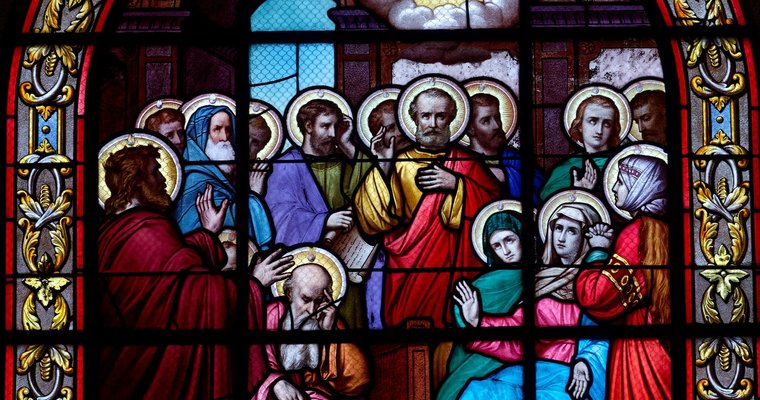
On the day of Pentecost the Holy Spirit enlivened Jesus' followers and gave the model that the Gospel must go to every group, ethnicity and place. The Holy Spirit guides, provides and moves us to keep coming even more alive in Christ. These themes should be preached throughout the year as well as on Pentecost.
Tips won't do turnarounds
Bill Easum in A Second Resurrection presents a convincing case that churches seldom turn around by following even the best proven tactical tips. Congregations grow as the Holy Spirit moves them from lukewarm to fired-up (Revelation 3:14-16).
Next Pentecost, I envision more pastors welcoming worshipers at the entrance with a hearty "Happy Birthday" and finishing the service with "Merry Pentecost," or a better phrase of their choosing.
 | Jim Farrer is the founder of Vital Signs Church Consulting and a member of the Society for Church Consulting. A broadly-trained church consultant, Jim is also a veteran of ministry positions in Canada and the U.S., he has trained leaders from 18 denominations and led seminars and coaching sessions nationwide. His articles have been published in the Journal of Evangelism and Missions and the Great Commission Research Journal. You can reach him by e-mailing revup1@yahoo.com or calling 814 629-5211. Learn More » |
More on Church Leadership and Administration
- The top seven regrets of pastors (by Thom Rainer)
- Five reasons why many pastors are inadequately paid (by Thom Rainer)
- The litmus test for successful ministry: always up and to the right? (by Charles Stone)
- 8 predictors of church growth (by Thom Rainer)