
If you’re leading alone, you’re limiting the mission

 Adobe
Adobe
 ChatGPT
In October 2019, the world watched something "impossible" happen…

Know who this is? This is Eliud Kipchoge—perhaps the greatest distance runner of all time.
Know what's going on? These are the very best distance runners in the world all coming together to do something that had never been done before.
It was always thought that a marathon (26.2 miles) could never be run in less than two hours. It was said to be impossible. It was thought to be an unbreakable barrier. It was believed that the human body is not capable of doing it!
Even Kipchoge couldn't do it. And he had won everything!
Kipchoge won the London Marathon 4 times.
Kipchoge won the Berlin Marathon 3 times.
Kipchoge won the Chicago Marathon.
Kipchoge won the Tokyo Marathon.
Kipchoge won the Gold medal in the 2016 and 2020 Olympics.
Kipchoge once ran a marathon in 2:01:39 . . . but could never break the two-hour barrier.
Until someone had an idea: What if we brought together the most elite runners in the world, not to compete against each other, but to collaborate! What if instead of them each trying to win, we had them work together and only run sections of the marathon (not the whole marathon) so they could pace Kipchoge, encourage Kipchoge, and cheer on Kipchoge? Maybe then, together, they could do the impossible.
And so on October 12, 2019 in Vienna, Austria, a team of world-class runners surrounded Kipchoge, each running only sections of the race, strategically pacing him, encouraging him, blocking the wind for him, and celebrating him.
The result? History was made! Kipchoge finished in an astonishing 1:59:40, shattering the so-called unbreakable barrier.
And I love the photo above, because it's the end of the 26.2 miles where he crosses the finish line. Behind him, celebrating, are the greatest runners in the world—not competing, but all coming together to do something that had never been done before.
This is a picture of the power of a small network!
As church leaders, we often believe we must run this race alone. But what if we didn't have to?
What if we ran as a pack with other leaders, supporting and pacing each other in ministry? What if, instead of competing, we collaborated?
This is the call of the church: to work together, to push one another forward, and to break barriers we never thought possible. When we embrace the power of a network, we can do more than we ever imagined.
And that's exactly what the 16% mission requires.
Have we missed the obvious?
I'm embarrassed to admit how often I've missed the obvious.
Sue and I were at our friends' house for dinner—Jim and Julie. We're close friends. The kind of friends who can show up unannounced and laugh at just about anything.
We were standing in their dining room talking when my eyes landed on a framed print hanging on their wall. And I blurted out, "I really like this print!"
Silence.
So, I doubled down: "No, seriously, I really like this print!"
And then they all lost it—full-on belly laughing…at me!
Finally, Sue said, "Well, you should like it. We gave it to them."
"Oh?" I said.
And then she added the knockout punch: "And we have the exact same print in our house."
Sometimes I miss the obvious!
For years, I poured my life into the mission of Jesus. Since I was twenty and decided to plant a church, I was all in on what we call the Great Commission—GO and make disciples.
In college, I even started something called the "Soul Winners Club." (Yes, it's as cringey as it sounds.) I harassed fellow students and guilted faculty into street evangelism because, you know… we're supposed to GO.
And then I matured some. We planted COMMUNITY with the mission of "helping people find their way back to God," and we developed B.L.E.S.S.—Begin with prayer, Listen, Eat, Serve, Story. We saw thousands come to faith. Beautiful fruit.
But I still had this nagging question:
Why aren't we seeing movement the way Jesus envisioned? What's missing?
Then the second "great" came into focus: the Great Commandment—LOVE. Love God. Love people. Not transactional Christianity. Transformational love. A whole gospel for whole people—justice, compassion, restoration.
Yes. We must GO. And yes, we must LOVE.
But even with both… something still felt incomplete.
And then one day, sitting in the back of a room while my friend Patrick O'Connell taught on the mission of Jesus, I saw what I'd missed! I had missed the obvious!
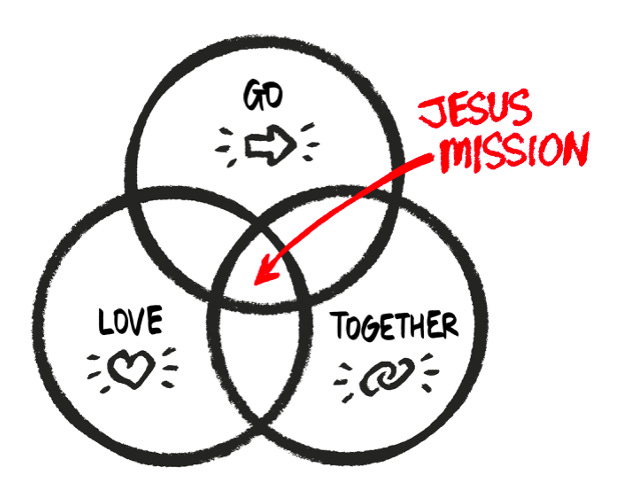
Patrick drew three circles.
The Great Commission: GO
The Great Commandment: LOVE
The Great Collaboration: TOGETHER
And then he added a third "great" from John 17: TOGETHER.He reminded us that Jesus prayed, "that they may be one… so that the world will know…" (John 17:22–23). Patrick called it: The Great Collaboration.
Together: The Great Collaboration
And I felt that "print on the wall" moment again. How did I miss something so obvious?
Because movement was never meant to be a solo journey. If we're going to GO and LOVE like Jesus, we've got to do it TOGETHER.
He added an arrow that pointed to the intersection of the three circles and titled it, "The Jesus Mission."
Multipliers alone aren't enough
In the previous article, we talked two essentials for reaching the "tipping point" of change and accomplishing the 16% mission.
Multipliers—healthy disciple-making leaders who champion reproduction are essential.
Networks- Multipliers who run together is the second essential.
Because multiplication is not just a leadership issue. It's an communal issue.
Even the healthiest leader struggles to sustain movement-level courage in isolation. And pastors—ironically—are among the most isolated people in the church. They preach community every week…while quietly lacking it themselves.
So what happens when leaders are alone?
- Vision shrinks.
- Risk tolerance decreases.
- Sending slows down.
Not because leaders stop believing in multiplication—but because loneliness makes preservation feel safer than release.
To reach 16%, we don't just need Multipliers. We need networks of Multipliers.
Thanks for reading! Subscribe for free to receive new posts and support my work.
What I mean by "networks"
When I say "network," I am not referring to an org chart or a denomination's official structure. I am talking about something much simpler—and much more powerful:
Small relational groups of leaders who meet monthly and commit to care for one another and hold each other accountable to multiplication. We call it being "friends on mission."
These aren't groups of competitors created for competition. They're groups of collaborators created for formation. They become the spiritual community pastors themselves need—the very thing they're trying to create in their churches.
And when pastors experience real spiritual community in a network, two things consistently happen:
They become healthier.
They multiply more.
Why networks make leaders healthier
Pastoral burnout rarely begins with overwork. It begins with carrying spiritual responsibility alone.
According to the Barna Group's "State of the Pastors" research project, "60%-70% of pastors report feel lonely or isolated."
But health multiplies in community. Networks become a safe place to review your RPMS with other multipliers.
Relationally — belonging replaces pressure
Mentally — perspective replaces anxiety
Physically — stress decreases
Spiritually — abiding becomes real again
Networks aren't just "nice." It's a matter of survival.
Research tells us that networks create healthier leaders…
According to Ed Stetzer and Warren Bird in Viral Churches, a church planter's likelihood of success increases by 125 percent when they participate in a peer-to-peer group.
The camaraderie, encouragement, and shared wisdom found in networks creates a lifeline for those on the frontlines of multiplication.
History tells us what happens when humans lose connection. In one horrific experiment centuries ago, infants were deprived of touch and relationship—and they died. Modern medicine calls it "failure to thrive." We are literally engineered for connection. If a lack of being "together" can kill a human body, can isolation also weaken the body of Christ? I think the answer is an honest, emphatic yes!
We are better together.
Why networks multiply churches
If the first outcome from networks is healthier leaders, the second outcome is the multiplying of more new churches!
Networks normalize multiplication, mobilization, and sending.
When a pastor stands alone, sending leaders feels dangerous. The risk feels irresponsible because the consequences feel personal.
But when they watch trusted friends send and survive—something shifts. Courage transfers relationally. Multiplication becomes expected.
The tipping point dynamic doesn't only apply to a nation. It applies to a circle of friends. Once reproduction becomes normal inside a small relational network, it spreads outward from a community to a city to a region to a nation. Vision travels at the speed of relationship.
I've seen it with my own eyes…
Years ago, I met a leader named Sam Stephens from India. His father started a mission that planted 200 churches from the mid-60's thru 1992. Impressive! But then Sam took over the mission and made some changes and began insisting on two things:
Multipliers: every church planter would apprentice another church planter every year—so reproduction happened every year. liers.
Networks: every church planter would belong to a small network for encouragement, accountability, and shared learning.
I asked Sam, "How has that worked?"
Sam casually said, "We have 70,000 churches so far."
Later that number grew to over 100,000!
And then he said a line I'll never forget:
"Churches working together in networks are the backbone of movement."
Backbone. Not accessory. Not optional. Not a "nice addition." Backbone.
I've seen the same dynamic up close in leading NewThing. When we started putting churches into networks of 3–6 leaders, simply "friends on mission"—something accelerated. Over time those networks didn't just plant churches; they reproduced networks. The movement became scalable and sustainable.
Movements don't emerge from lone rangers. Multiplication doesn't happen in isolation.
What happens in a network gathering (N-E-T)
So, what happens in a network gathering. We've tried to keep the rhythm simple and repeatable. Meet every month and use the N-E-T in network to remind you what to do…
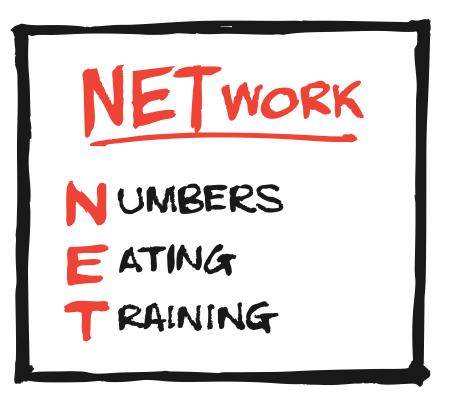
N — Numbers
Not attendance numbers—multiplication numbers.
Review your multiplication goals. Who are we discipling? Who are we developing? Who are we sending? Where are we planting new churches?
Clarity fuels courage.
E — Eating
We share a meal. Food turns acquaintances into friends. We are "friends on mission."
Because friendship isn't a side benefit—it's part of the engine.
T — Training
Offer training so leaders leave better equipped than when the when they arrived.
Not a conference. Not a lecture circuit. Shared learning—real experiments, real wins, real failures, real wisdom.
N-E-T: Simple. Repeatable. Powerful.
Networks are trying to happen
Warren Bird, a premier research, tells us that networks like we have been describing are trying to happen! In a recent major research project he discovered the following:
"43% of churches planted in the last five years say part of their vision for the future is a multiplying network of churches"
Why is this so encouraging? Because this tells me what Jesus has been wanting since he prayed for it in John 17 is the exact same thing 43% of church planters say they want. They want to be a part of the Great Collaboration. They want to work together for the sake of the mission in small multiplying networks.
Now, they are not doing it . . . yet. But they want to! It is trying to happen. Let me repeat, this is what is trying to happen!
Let's do a deeper
If 43 percent of them have a vision for "a multiplying network of churches," that means somewhere between 6,450 and 8,600 new churches have a dream or vision for starting a network of multiplying churches. To keep it simple, let's say 7,500 churches share that vision of a multiplying network.
So if there are 7,500 churches over the last five years with this vision, I will also assume there will be another 7,500 over the next five years with the same dream/vision for starting or participating in "a multiplying network of churches."
Over the course of a decade, that means about 15,000 new churches are dreaming of "a multiplying network of churches."
Consider this: If we can help these churches from the last five years start multiplying networks, and the churches in the next five years do the same, that will push us closer to "tipping point" territory of 16% of all churches in the U.S. reproducing and multiplying.
Why this matters for the 16% mission
Here's what gives me enormous hope: …collaboration is trying to happen.
And whenever something is trying to happen, that's where a wise leader leans in.
If enough Multipliers stop trying to run alone—and start running together—16% stops feeling like a dream and starts feeling like a trajectory. It is a simple equation:
Multipliers + networks = 16%
Because 16% isn't reached by convincing everyone. It's reached when enough connected leaders live a different way together long enough that multiplication becomes normal.
Don't run the race alone

Kipchoge didn't break the barrier because he tried harder. He broke it because a team formed around him—pacing him, protecting him from the wind, handing him what he needed at the exact moment he needed it. The breakthrough was personal, but the pathway was collaborative.
The 16% mission is the same. We're not chasing a trend—we're breaking a barrier. And barriers don't fall because one leader runs faster. They fall when enough leaders refuse to run alone.
So don't just admire the story—join the formation. Find 3–5 friends on mission. Meet monthly. Practice N-E-T. Pace each other. Protect each other. And together, we'll see what "impossible" looks like when the church finally goes…and loves…together!
Join a network
Find a network—you are looking for a small group of leaders who are committed to being Multipliers. The size isn't as important as it being small enough to care and large enough to dare. Join them in meeting monthly.
Start a —don't wait for permission. If you can't find a network - start one!
Imagine if every U.S. city over 100,000 people—roughly 330 cities—contained dozens of relational pastor networks.
Now expand that across affinity groups:
- Rural pastors who feel forgotten
- Urban neighborhood leaders
- Bi-vocational pastors
- Next-generation leaders
- Immigrant church leaders
- Marketplace pastors
- Microchurch pioneers
- Multiethnic leaders
- Denominational renewal leaders
Thousands of small relational networks who are "friends on mission." Not a giant structure—a living movement. That's how cultures shift.
Because movements don't grow on our own and all alone. They grow through courageous friendships sustained long enough to change what everyone believes should be normal. And when that normal crosses 16%…
It will be a "tipping point" for changing a nation.
 | Dave Ferguson is the CEO / President and co-founder for Exponential. He is also the lead pastor of Community Christian Church, an innovative multi-site missional community that is passionate about “helping people find their way back to God.” Community has grown from a few college friends to thousands every weekend meeting at multiple locations in the Chicago area and has been recognized as one of America’s most influential churches. Learn More » |
More on Leadership Development & Discipleship
- How should pastors organize their libraries? (by Thom Rainer)
- The causes and cure for leadership burnout (by Charles Stone)
- 11 traits of churches that will impact the future (by Carey Nieuwhof)
- Why wise leaders choose kindness (by David Bowman)