
The greatest danger to your leadership

 Adobe
Adobe
 ChatGPT
I want to tell you a story—and as I do, I want you to listen not just as a reader, but as a leader reflecting on your own journey.
It begins with a small group of pastors in Chicago. I was in this small group.
Not young leaders just starting out. We were seasoned pastors—gifted, respected, leading large and growing churches. People looked to us for wisdom. Everyone assumed they were thriving.
But over time, something unsettling began to surface.
One by one, several of these leaders drifted.
Not suddenly.
Not publicly.
Not intentionally.
They didn't wake up one morning and decide to compromise their integrity, neglect their families, or take advantage of their power or position. They simply stopped paying attention to a few critical things. Unchecked pace. Quiet exhaustion. Subtle isolation. Small decisions. They drifted.
Eventually, several found themselves in places they never intended to be—relationally, physically, mentally, or spiritually.
If I were to attempt to assemble a reunion of that group today, several of the seats would be empty.
- Some vacated their seats because of inappropriate relationships with women.
- Some seats would be empty because of financial impropriety and how they handled money.
- Other seats would be unfilled because of the toxic cultures they created and from which they benefited.
How could that happen? They drifted.
Hebrews 2:1 reminds us: "We must pay the most careful attention, therefore, to what we have heard, so that we do not drift away."
As you read that, let me pause and ask you: Have you ever looked up and thought, How did I get here? Or watched someone you respect slowly drift in ways that surprised you?
If so, you're not alone.
Drift is rarely dramatic
Here's what that small group taught me: Drift doesn't come from bad intentions. It comes from neglected gauges.
Most leaders don't drift because they stop caring about the mission. In fact, it's often the opposite. The mission keeps advancing while their inner life quietly lags behind.
That realization unsettled me—because I could see myself in it.
It forced me to ask a deeper question—not just How do we grow and reproduce churches?But How do we grow and reproduce leaders who last?
So let me turn that question toward you: What has helped you last so far—and where do you feel most vulnerable right now?
There is a movement inside you
In the heart of every Multiplier is a simple but hopeful conviction: there is a movement in me!
- Not a movement you manufacture.
- Not a strategy you download.
- A movement God has already placed within you.
Maybe you are doubting there is movement-making potential inside you. I will have a lot more to say about that in the future.
For now, set aside your doubts and accept this possibility: there is movement-making potential in you!
The greatest danger to your leadership and the movement-making potential that God has placed within you is drift! Slow…subtle…isolated…compromises…that move you out of alignment with God's Spirit.
But here's what I've learned: movements don't start with what we do. They start with who we are becoming.
Healthy leaders multiply and advance the mission.
Unhealthy leaders—no matter how gifted—eventually limit the mission.
Multiplier is not a book about doing more. It's about becoming healthy enough to reproduce what matters most.
Let me ask you something personal: When you think about your leadership, what do you most hope will multiply through you—five, ten or twenty years from now?
That answer matters more than you might realize.
The Multiplier Tool: Health That Leads to Impact
Over years of leadership, coaching, and reflection, a simple framework emerged—one that helped me name what I was seeing and gave leaders a way to course-correct before drift became destructive.
I call it The Multiplier Tool.
It's built around two movements: first is leading your inner world to transformation and second is leading others in your outer world to multiplication. Let's spend some time on the former and briefly introduce the latter.
The Four Gauges (Your Inner World)
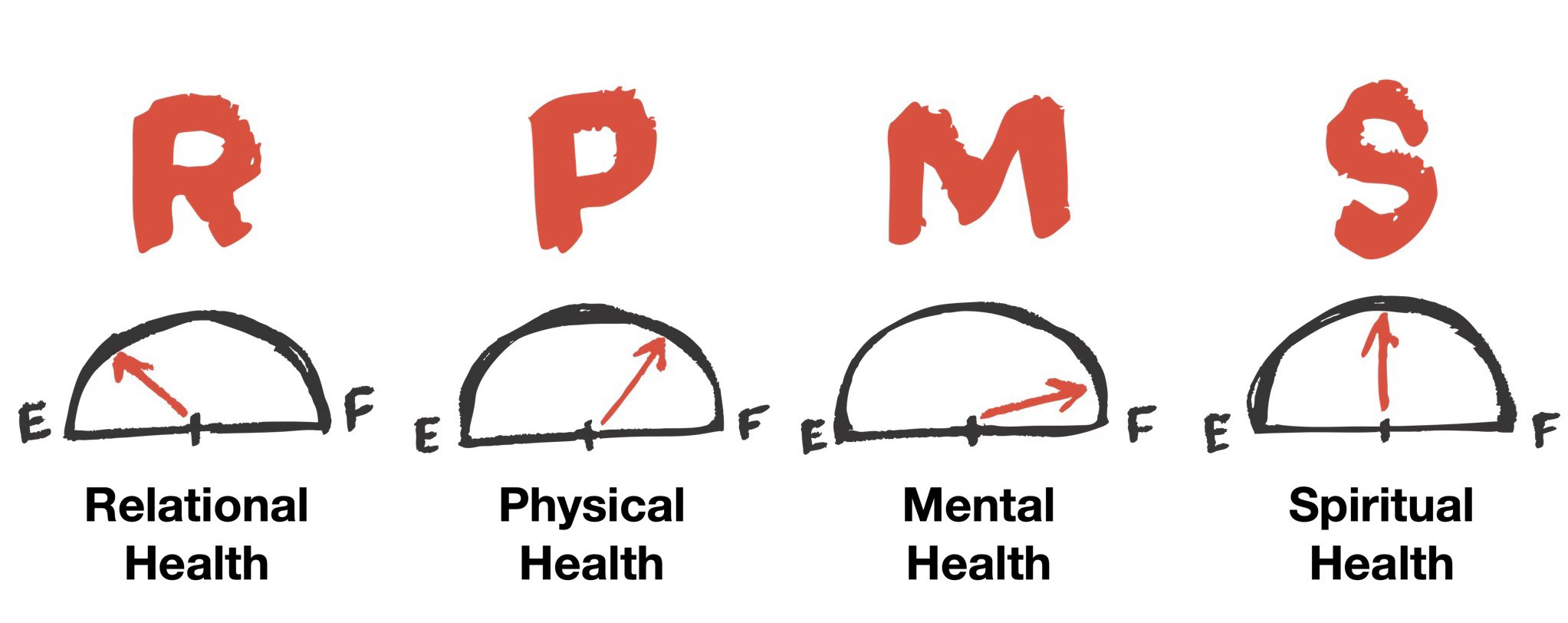
These gauges quietly determine your long-term impact:
- Relational – How healthy are your closest relationships?
- Physical – Is your body supporting or sabotaging your leadership?
- Mental – Are your thoughts aligned with truth, clarity, and hope?
- Spiritual – Are you abiding—or just producing?
You reproduce who you are. And you reproduce what you do. (Re-read those last two sentences. If I could only give you one piece of leadership advise that would be it!)
Here's an honest check-in: Which of these gauges tends to drift first for you? And how do you usually respond when it does?
If you're willing, name it in the comments. Naming it is often the first step toward health
The Four Practices (Your Outer World)
From health flows impact. These practices help leaders multiply their inner transformation in others and catalyze movement.
- Make Disciple Makers–reproduce the way of Jesus in others.
- Establish Spiritual Communities–places where people are known, loved and commissioned.
- Mobilize New Leaders–empowering everyday people for mission.
- Launch New Expressions–multiply the mission through new forms of church.
These aren't programs. They're practices—simple, repeatable, and scalable.
Here's what I've noticed: leaders don't struggle to believe in these practices. They struggle to live them consistently while staying healthy.
So let me ask you: Which of these practices feels most natural to you—and which one tends to get pushed aside when things get busy?
 | Dave Ferguson is the CEO / President and co-founder for Exponential. He is also the lead pastor of Community Christian Church, an innovative multi-site missional community that is passionate about “helping people find their way back to God.” Community has grown from a few college friends to thousands every weekend meeting at multiple locations in the Chicago area and has been recognized as one of America’s most influential churches. Learn More » |
More on Spiritual Growth and Soul Care
- My pleasure! (by Richard Blackaby)
- Follow forward without fear (by Tim Tucker)
- LEGO’s founder on how godly play—not just productivity—pleases God (by Jordan Raynor)
- Turning failure into faithful progress (by David Bowman)